
Most businesses treat their customers like a one-night stand. They spend thousands on a “hook” (the ad), they try to close the sale immediately, and when the customer doesn’t buy, they act surprised. Then, they blame the ad platform. They blame the economy. They blame the competition.
But the reality? They lost the sale the moment they decided to ignore the customer journey.
Marketing isn’t a single event. It’s a relationship. If you try to force a commitment from a stranger, you’ll get ghosted every time. To win in today’s market, you have to guide the customer through the “Messy Middle”—that chaotic space between “I have a problem” and “I’m ready to buy.”
If your marketing strategy isn’t mapped to the customer journey, you aren’t building a business; you’re just paying for traffic you aren’t prepared to handle.
What is the Customer Journey?
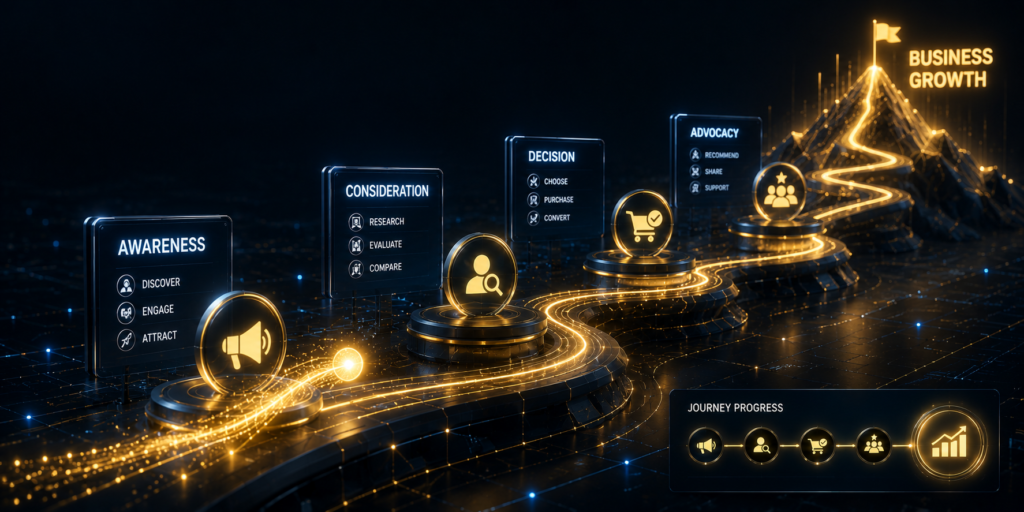
The customer journey is the sum of every interaction a prospect has with your brand, from the first time they see your name to the moment they become a loyal advocate.
It’s not a straight line. It’s a messy, non-linear loop of research, comparison, hesitation, and validation. In the past, this was simpler. Today, a customer might see your ad on Instagram, read a review on Google, ask an AI assistant for a comparison, and then finally visit your site via email.
If you view these interactions as “siloed” events—treating your social media team, your email team, and your web team as separate entities—you’re losing the customer. The customer journey is the unified experience of your brand. If that experience breaks at any point, the sale disappears.
How Businesses Can Use the Journey to Scale
If you want to stop leaking revenue, you need to map your entire process to the customer’s state of mind. Here is how you do it:
1. Match Content to the Intent
Stop pushing “Buy Now” ads to people who have never heard of you. That’s like asking for marriage on the first date. Use awareness content (blogs, videos, educational guides) to solve the problem they have. Once they know you, then you introduce the consideration content (case studies, comparisons). Only then do you pitch the sale. Match the message to the stage of the journey.
2. Optimize the “Messy Middle”
Most drop-offs happen because the customer gets confused or loses trust. Are you providing the right information when they are comparing you to your competitors? Do you have clear, visible social proof? By identifying the exact points where leads “go cold,” you can intervene with targeted remarketing or helpful content to bring them back.
3. Unify Your Data
If your sales team doesn’t know what your marketing team is doing, your customer feels it. Use a CRM to track the journey. When a lead moves from “clicked an ad” to “downloaded a guide” to “booked a call,” your messaging needs to evolve. A unified view of the journey allows you to provide a personalized experience that feels like a conversation, not a spam campaign.
4. Build for Advocacy
The journey doesn’t end at the sale; that’s where the growth begins. Your best customers should be your best salespeople. Use the post-purchase phase to provide value, solicit feedback, and incentivize referrals. A customer who has had a great journey will do more for your bottom line than any ad campaign ever could.
How Brand Reflex Does It Out of the Box
At Brand Reflex, we don’t just “run ads.” We architect the entire path from stranger to advocate. We know that most agencies are obsessed with the “click,” but we are obsessed with the “conversion lifecycle.”
1. Full-Funnel Journey Mapping
We don’t just look at your ad performance; we look at the entire map. We identify every touchpoint where a lead could potentially drop off. We fix the broken links, refine the messaging at each stage, and ensure that your brand identity remains consistent whether they are watching a TikTok or reading your technical whitepaper.
2. Content That Bridges the Gaps
We build content libraries that speak to the specific anxieties of your prospects at every stage. We write for the “researcher,” the “comparer,” and the “buyer.” By providing the right answers at the right time, we shorten your sales cycle and build trust faster than your competitors can.
3. Unified Tracking & Attribution
We hate silos. We implement tracking that follows your customer through the entire journey. We can see which ad started the conversation, which email nurtured the lead, and which piece of content finally convinced them to buy. We use this data to ruthlessly optimize your funnel, cutting the fat and doubling down on what actually moves the needle.
4. Performance-Integrated Branding
We bridge the gap between “brand” and “direct response.” We ensure your branding is strong enough to be memorable, and your performance tracking is tight enough to be profitable. We don’t make you choose between having a great reputation and having great sales—we give you both.
The Bottom Line
The companies that win aren’t the ones with the loudest ads; they are the ones with the most helpful journeys. If you stop trying to “trap” your customers and start trying to “guide” them, everything changes.
Stop treating marketing like a transaction and start treating it like a relationship. Map the journey, fix the leaks, and guide your customers to the finish line.
Ready to see exactly where your leads are getting stuck? Let’s map your funnel.
Ready to scale your leads? Visit Brand Reflex and let’s map your customer journey for maximum growth.
Frequently Asked Questions
- Q: What is the biggest mistake businesses make with their customer journey?
- A: The biggest mistake is assuming the journey is linear or treating it as a series of disconnected marketing campaigns. Leads often jump between channels, and if your messaging isn’t unified, they lose trust and drop off.
- A: The biggest mistake is assuming the journey is linear or treating it as a series of disconnected marketing campaigns. Leads often jump between channels, and if your messaging isn’t unified, they lose trust and drop off.
- Q: How do I identify where my customers are dropping off?
- A: Use behavioral analytics (like heatmaps and session recordings) and CRM tracking to see where leads stop engaging. If you have high traffic but low conversions, check your landing page load times and call-to-action clarity.
- A: Use behavioral analytics (like heatmaps and session recordings) and CRM tracking to see where leads stop engaging. If you have high traffic but low conversions, check your landing page load times and call-to-action clarity.
- Q: How does the customer journey affect my ad spend?
- A: Understanding the journey prevents “wasted” ad spend. By knowing which leads are at which stage, you can retarget them with relevant content instead of repeating the same generic ad, lowering your CPA significantly.
- A: Understanding the journey prevents “wasted” ad spend. By knowing which leads are at which stage, you can retarget them with relevant content instead of repeating the same generic ad, lowering your CPA significantly.
- Q: Can AI help me map the customer journey?
- A: Yes. AI can analyze vast amounts of interaction data to predict where a lead is in their journey and suggest the specific content or message that will move them to the next stage.