

The search bar, as we’ve known it for the last two decades, is going through an identity crisis.
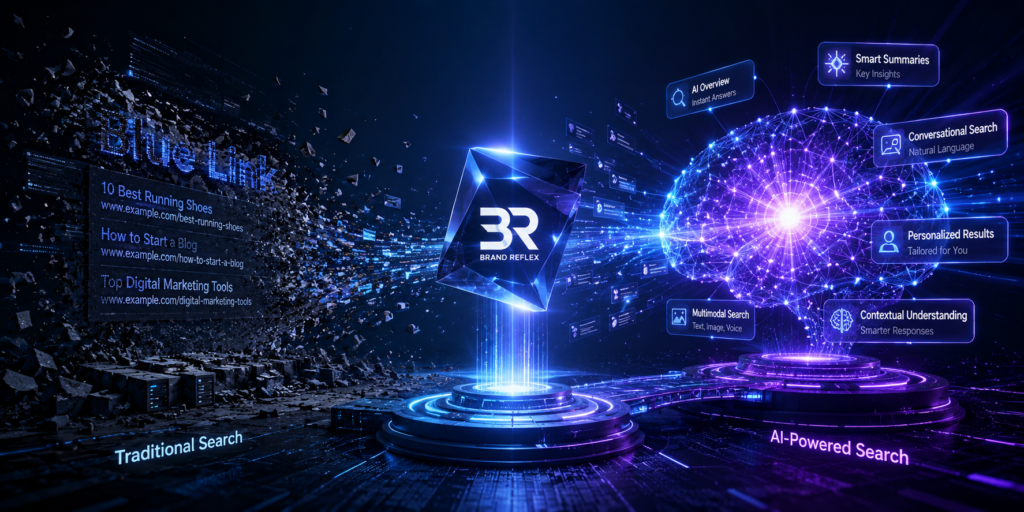
For years, we’ve lived by the gospel of the “Ten Blue Links.” We chased algorithm updates, keyword density, and backlink profiles like they were the keys to the kingdom. We treated Google like a librarian—you ask a question, and it hands you a list of books to read. But that era? It’s sunsetting, Dev.
The new reality is powered by AI, Large Language Models (LLMs), and a fundamental shift in how humans interact with the internet. We aren’t just searching anymore; we are conversing. And if you’re still pinning your entire digital strategy on traditional SEO tactics from 2020, you aren’t just falling behind—you’re becoming invisible.
Welcome to the era of Generative Engine Optimization (GEO).
What is Generative Engine Optimization?
At its simplest, Generative Engine Optimization is the process of optimizing your content to be understood, cited, and recommended by AI-powered search engines.
Think about how you use ChatGPT, Google’s AI Overviews, or Perplexity. You don’t type “best marketing agency India” and click on the third result. You ask, “Which marketing agency can help my brand scale with performance-led branding?” and you expect a comprehensive, synthesized answer.
GEO is the bridge between your brand’s expertise and these AI engines. It’s no longer about ranking for a specific keyword in a list. It’s about becoming the source of truth that the AI pulls from when it crafts its response.
Traditional SEO was about “tricking” or “pleasing” an algorithm to rank higher on a SERP (Search Engine Results Page). GEO is about providing high-authority, nuanced, and structured information that generative engines recognize as the most accurate answer to a user’s query. It’s about becoming an entity that the AI trusts.
How Can Businesses Use GEO to Dominate?
If you’re a business owner, you might be thinking, “This sounds complex. Do I need to be a coder?” The answer is a resounding no, Dev. You need to be a thought leader.
When an AI builds a response, it’s not just looking for keywords; it’s looking for consensus, clarity, and authority. Here is how you can leverage GEO to improve your business:
1. Shift from Keywords to Topical Authority
Stop obsessing over long-tail keyword strings. Start obsessing over topics. If you are in the branding space, don’t just write a blog about “branding tips.” Write a deep, research-backed guide on “the psychological impact of brand identity on Gen Z consumers.” By covering a topic from every conceivable angle, you signal to AI engines that your brand is the authority on the subject.
2. Answer Questions Directly (The AEO Connection)
AEO (Answer Engine Optimization) is the cousin of GEO. AI engines crave direct, concise answers. Structure your content with clear H2 and H3 headings that pose questions, followed by direct, authoritative answers. If the AI can lift a paragraph from your site and use it as a complete answer, your brand gains instant visibility and credibility.
3. Focus on “Brand Mentions” and Sentiment
Generative engines prioritize sources that are frequently cited and respected within the industry. If people are talking about your brand—both positively and across reputable platforms—the AI takes note. High-quality PR, guest contributions on authoritative sites, and strong social proof are no longer just “nice to haves”; they are essential inputs for GEO.
4. The Human Element (E-E-A-T)
AI engines are trained to avoid hallucinated or low-quality content. They look for Experience, Expertise, Authoritativeness, and Trustworthiness (E-E-A-T). Real-world case studies, unique perspectives from your team, and proprietary data are your strongest assets. The AI wants to cite real human experience, not another rehashed version of a generic article.
How Brand Reflex Does It Out of the Box
At Brand Reflex, we don’t just watch the shift—we engineer it. While most agencies are still panicking over plummeting organic traffic, we are busy architecting “AI-ready” ecosystems for our clients.
Here is how we do it differently:
1. The Entity Mapping Strategy
We don’t just optimize for words; we optimize for entities. We help Google and other generative engines understand exactly who your brand is, what you stand for, and how you connect to the wider industry ecosystem. We build a “Knowledge Graph” for your brand that makes you virtually impossible for AI to ignore.
2. Conversational Content Engineering
Most agencies write for bots. We write for humans—and then we “seed” that content with the structural markers AI needs to digest it. We utilize structured data (Schema Markup) to feed the engines exactly what they need to feature your content in AI-generated answers, snippets, and recommendations.
3. Performance-Led Branding
We know you aren’t just looking for impressions; you’re looking for leads. Our GEO approach is fused with performance marketing. We ensure that when the AI recommends your brand, it does so in a way that drives intent-based traffic to your site. We optimize for the user’s journey, not just the user’s search.
4. Proprietary Data Amplification
We don’t believe in recycled content. Brand Reflex works with you to pull the “hidden gems” out of your business—your unique methodologies, your proprietary research, and your raw case studies. We package this data so that AI engines treat your brand as the primary source for industry insights.
The Bottom Line
The “death of traditional SEO” isn’t a funeral—it’s a rebirth. It’s an opportunity to stop fighting for a blue link and start fighting to be the answer.
The businesses that embrace GEO today will be the ones that own the market tomorrow. They will be the brands that AI engines consistently “recommend” to users, effectively automating their lead generation at the highest level of trust.
Don’t wait for the search landscape to finish shifting before you decide to move. By the time the dust settles, the brands that acted early will have already secured their place in the AI-generated future.