

Let’s be honest: the days of relying solely on “blue link” traffic for your online store are fading. Your customer isn’t just typing “buy black leather boots” into a search bar anymore. They are asking their smartphone, their home assistant, or their favorite chatbot, “What are the best waterproof leather boots for cold weather that look professional?”
And in a fraction of a second, the AI—not the traditional search engine—is deciding which products to recommend.
If your product pages are still written for the search algorithms of 2018—stuffed with keywords, short descriptions, and zero context—you aren’t just invisible. You’re disqualified. This is where AEO (Answer Engine Optimization) for ecommerce changes everything. It’s no longer about ranking for a term; it’s about being the product that the AI assistant confidently suggests.
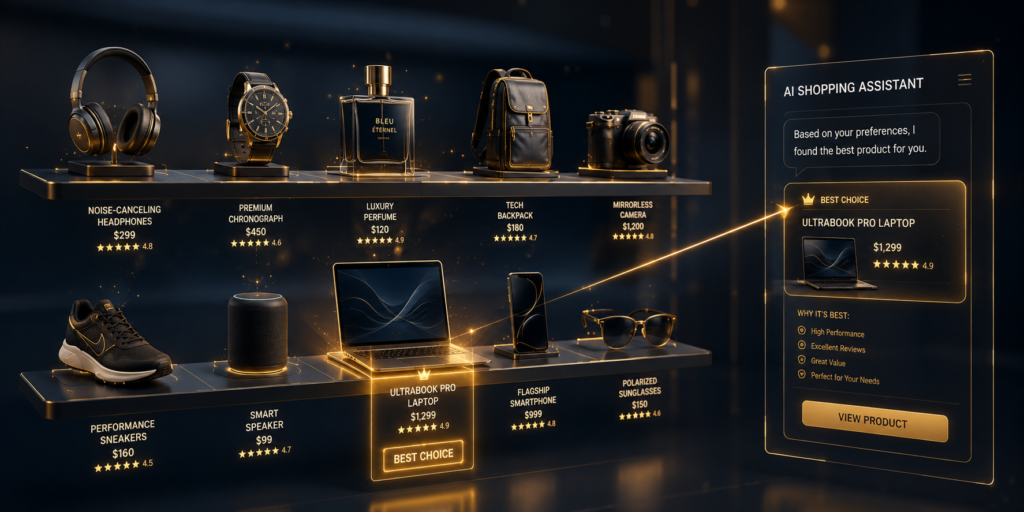
What is AEO for Ecommerce?
Ecommerce AEO is the practice of optimizing your product catalog, site architecture, and content so that generative AI engines (like ChatGPT, Perplexity, or Google’s AI Overviews) identify your products as the definitive solution to a customer’s query.
In traditional SEO, you wanted to rank in the top ten. In the AEO era, you want to be the “Top Recommendation.”
Think about how an AI works. It doesn’t look for the site that paid for the most backlinks. It looks for the product with the best attributes, the most social proof, the clearest description, and the most logical fit for the user’s specific problem. AEO for ecommerce means feeding the AI the exact data it needs to build a “case” for why your product is the only one worth buying. It’s a shift from “search-centric” to “answer-centric” product data.
How Ecommerce Brands Can Use AEO to Win
If you want to stop fighting for scraps and start owning the AI-generated recommendations, you need to change how you present your inventory. Here is the AEO playbook for ecommerce success:
1. Move Beyond Keyword Stuffing to “Attribute-Rich” Descriptions
AI engines are obsessed with attributes. If you sell a coffee machine, don’t just say “Great coffee machine.” The AI needs to know the material, the capacity, the grind settings, the ease of cleaning, and the specific taste profile. When you structure your product descriptions to answer questions before they are asked, you make it incredibly easy for an AI to cite your product as the answer to “How do I make barista-quality espresso at home?”
2. Optimize for “Natural Language” Queries
People don’t speak in keywords; they speak in problems. Your product pages should answer the “Why” and the “How.” Instead of just listing features, write descriptions that explain the use case. “Best for small apartments,” “Perfect for busy parents,” or “Designed for professional durability.” When the AI parses the query “What coffee machine should I get for a small apartment?”, it will find your product because you answered that specific question in your copy.
3. Leverage Structured Data (Schema) as Your Salesman
Structured data is the language of AI. It tells the search engine, “This is a product, this is the price, this is the availability, and these are the ratings.” If your site lacks deep schema, the AI is effectively flying blind. By using rigorous, high-level product schema, you give the AI everything it needs to display your product with rich details in its recommendation, increasing the chances of a click significantly.
4. Social Proof is an “Answer Signal”
Generative engines love consensus. They look for signals that other humans have vetted your product. Integrate your customer reviews into your structured data. When an AI “reads” that your product has a 4.8-star rating from 500 verified customers, it views that as a trust signal. It makes your product a “safer” recommendation for the AI to make.
How Brand Reflex Does It Out of the Box
At Brand Reflex, we don’t just upload products. We build “AI-Ready” product ecosystems. We recognize that the future of ecommerce isn’t just about traffic—it’s about “recommendability.”
1. The “Entity-Based” Catalog Audit
We don’t view your product list as a spreadsheet; we view it as a library of answers. We audit your catalog to ensure every product has a distinct, descriptive, and AI-readable identity. We clean up the “messy” data that confuses AI and replace it with a structured, clear profile that machines love to crawl and cite.
2. Conversational Content Engineering
Most ecommerce brands have boring descriptions. We rewrite them to be “conversational.” We ensure your copy feels like it was written by an expert, not a robot. This serves a dual purpose: it builds trust with human shoppers, and it provides the exact “natural language” structure that generative AI looks for when recommending products.
3. Schema Strategy for High-Intent Queries
We implement advanced, custom schema that goes deeper than the basics. We tell the machines the granular details—the “Use Cases,” the “Compatibility,” the “Material Benefits”—that usually get ignored. This gives your products a massive competitive advantage in generative search, where the AI needs to prove why it’s recommending a specific item.
4. Performance-Integrated Ecommerce
We know you aren’t looking for “cool AI results”—you’re looking for revenue. We bridge the gap between AEO and ROI. We make sure that our AEO strategy drives traffic to product pages that are already optimized for high conversion. We don’t just want the AI to talk about your product; we want the AI to drive a customer who is ready to checkout.
The Bottom Line
The future of ecommerce shopping isn’t just about finding the right store; it’s about asking an AI to find the right solution. If your brand isn’t part of that “solution set,” you’re missing out on the most high-intent traffic the internet has ever seen.
The brands that thrive in the coming years will be the ones that understand that AI-readability is just as important as user-readability. It’s time to take your product data, your content, and your site architecture, and align them with the way the world is actually shopping today.
Don’t wait for the algorithms to change. Build a brand that the machines want to talk about.
Frequently Asked Questions
- Q: How does AEO for ecommerce differ from traditional product SEO?
- A: Traditional product SEO focuses on ranking for high-volume keywords. Ecommerce AEO focuses on “answerability”—optimizing your product data so AI assistants can immediately explain why your product is the best solution for a customer’s specific problem.
- A: Traditional product SEO focuses on ranking for high-volume keywords. Ecommerce AEO focuses on “answerability”—optimizing your product data so AI assistants can immediately explain why your product is the best solution for a customer’s specific problem.
- Q: What are “attribute-rich” product descriptions?
- A: These are descriptions that go beyond basic features to include granular details like specific use cases, materials, compatibility, and problem-solving benefits. AI engines need these details to match your product to complex user queries.
- A: These are descriptions that go beyond basic features to include granular details like specific use cases, materials, compatibility, and problem-solving benefits. AI engines need these details to match your product to complex user queries.
- Q: Does AEO make traditional ecommerce product pages obsolete?
- A: No, but it makes them more demanding. Product pages now need to serve both human shoppers and AI parsers. By combining clear, human-centric benefits with structured, machine-readable data, you capture traffic from both sources.
- A: No, but it makes them more demanding. Product pages now need to serve both human shoppers and AI parsers. By combining clear, human-centric benefits with structured, machine-readable data, you capture traffic from both sources.
- Q: How do I get an AI assistant to recommend my product over a competitor’s?
- A: You win by feeding the AI better context. Use high-quality schema markup, highlight verified customer reviews in your structured data, and provide clear, conversational content that directly addresses the “why” behind your product’s value.
Ready to dominate AI product recommendations? Visit Brand Reflex and let’s turn your catalog into an AI-ready revenue machine.