

If you’ve been digging through your search console lately, you’ve probably noticed something strange. The way people are finding your business is shifting. You’re seeing traffic patterns that don’t align with traditional “blue link” click-through rates. You’re seeing terms like “AI Search,” “GEO,” and “AEO” popping up in industry forums, and if you’re like most business owners, it feels like the digital marketing alphabet soup has finally hit its boiling point.
Let’s clear the air. There is a lot of panic in the industry right now. Agencies are trying to sell you on “The Future” by throwing acronyms at you to mask the fact that nobody really knows what’s going on.
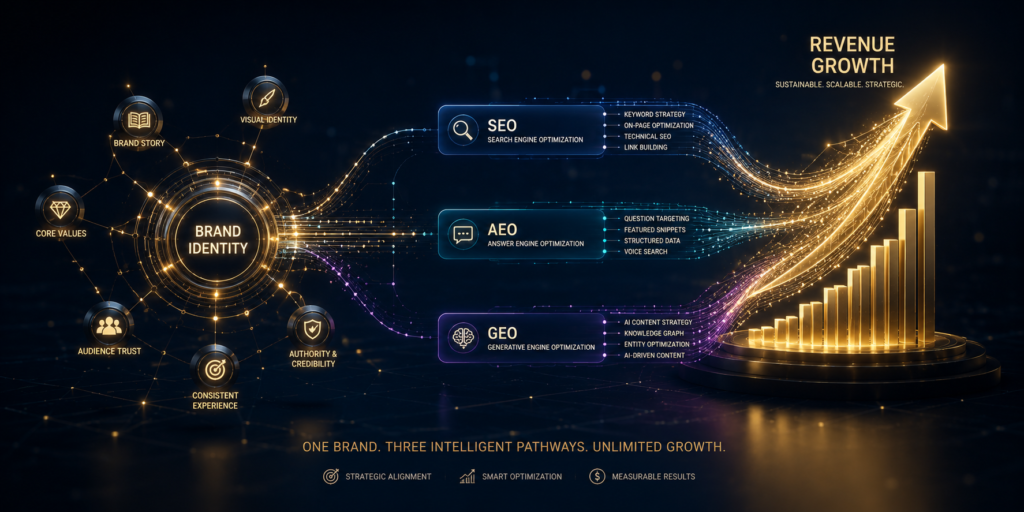
But here is the reality: You don’t need to choose between SEO, AEO, and GEO. You don’t need a different strategy for each one. What you need is to stop thinking about “search” as a game of ranking and start thinking about it as a game of authority.
What is the Alphabet Soup? (SEO vs. AEO vs. GEO)
To win, you first have to understand what these terms actually represent. They aren’t mutually exclusive strategies; they are different eras of the same goal: being seen by your customer.
1. SEO (Search Engine Optimization): The “Library” Era
This is the old guard. Traditional SEO is about building relevance through keywords, links, and technical health. It’s like being a book in a library. If your title is right, your cover is attractive, and other librarians recommend you, you get checked out. It’s reliable, it’s stable, and it’s still the bedrock of the internet.
2. AEO (Answer Engine Optimization): The “Assistant” Era
AEO is what happens when you ask Siri or Alexa a question. It’s about being the direct answer. When you search for “What is the best CRM for small business?” and the engine gives you a snippet—a specific paragraph that answers the question—that is AEO. It’s about conciseness, structure, and being the best direct source of information.
3. GEO (Generative Engine Optimization): The “Co-author” Era
This is the frontier. When you use ChatGPT, Google’s AI Overviews, or Perplexity, you aren’t getting a list of links; you are getting a synthesis. The AI reads the web, takes what it needs, and writes a unique answer for you. GEO is the art of ensuring your brand’s data, reputation, and insights are the ingredients the AI uses to bake that answer.
And where do “Content” and “Marketing” fit? They are the fuel. Without high-quality content that carries your brand’s unique voice, you have nothing to optimize for. Marketing is the strategy that ensures that voice is heard by the right people, regardless of whether it’s through a link, a snippet, or a generative summary.
How Businesses Can Use This to Improve Their Bottom Line
Stop obsessing over the acronyms and start obsessing over your customer’s intent. Whether the search engine is a list of links or a robotic brain, the goal remains the same: solving a problem for a human.
Here is how you leverage this new reality to drive real growth:
1. Stop Siloing Your Strategy
The biggest mistake businesses make is hiring an SEO firm, a content writer, and a PR agency that never talk to each other. In the era of AI search, these are all the same thing. Your technical site health (SEO), your direct answers (AEO), and your brand authority (GEO) must be unified. If your content doesn’t back up your technical performance, the AI won’t trust you.
2. Optimize for “Entity” Recognition
The machines want to know who you are. This is the secret to moving from SEO to GEO. You need to map your business as an “entity.” Does your brand have a consistent NAP (Name, Address, Phone)? Is your leadership team profiled on industry sites? Do you have proprietary data that you cite consistently? The more the machines can link your brand to specific concepts, the more likely you are to be the “source of truth” in an AI response.
3. Lean into E-E-A-T (Experience, Expertise, Authoritativeness, Trustworthiness)
This isn’t just a Google buzzword; it’s a survival mechanism for the age of AI. AI models are trained to avoid hallucinating. They need expert human sources to stay relevant. If you publish generic, rehashed content, you are giving the AI nothing to cite. You need to publish content that is filled with experience—things that only you or your team could possibly know.
4. Build a “Help Engine”
If you want to win AEO, stop writing “articles” and start writing “answers.” Look at the common questions your customers ask during a sales call and turn those into content. Structure them with clear headings. Use data tables. Be direct. When an AI searches for a solution to a specific pain point, your site should be the one that provides the clearest, most authoritative answer.
How Brand Reflex Does It Out of the Box
At Brand Reflex, we don’t believe in chasing algorithms. We believe in building digital footprints that are impossible to ignore. While other agencies are arguing about whether SEO is dead, we are busy building ecosystems that thrive in the new search landscape.
1. The Unified Authority Framework
We don’t do “SEO projects.” We do “Authority Building.” We take your branding, your performance data, and your technical content strategy and merge them into one. We ensure that when the machines look at your business, they don’t see a fragmented set of pages; they see a clear, powerful, and authoritative brand entity.
2. AI-Ready Data Architecture
We are one of the few agencies that understands that the future of search is data-driven, not just keyword-driven. We implement sophisticated Schema Markup and “Entity Mapping” that feeds the AI the exact information it needs to categorize your business as a leader in your niche. We make sure the machines know exactly who you are, what you offer, and why you should be the recommendation.
3. Content That Actually Converts
Most agencies create content for “bots” to rank. We create content for humans to buy. We use our performance marketing background to ensure that your “authoritative” content is also your “conversion” content. We map your content pillars to your sales funnel so that the traffic you gain from AEO or GEO isn’t just a vanity metric—it’s a high-intent lead.
4. Performance-Led Transparency
We don’t hide behind confusing acronyms. You won’t hear us talking about “backlink velocity” or “keyword difficulty” as if they are the only things that matter. We talk to you about revenue. We talk about how your brand is showing up in AI results, how your conversion rates are improving, and how your market share is growing. We give you a clear, honest, and high-performance view of your digital presence.
The Bottom Line
Is SEO dead? No. It’s evolving into something much more complex and rewarding. AEO isn’t a new burden; it’s a way to become the “go-to” answer. And GEO? It’s simply the ultimate test of your brand’s authority.
The businesses that win in the next five years won’t be the ones that hack the most links. They will be the ones that have the most to say, the clearest way of saying it, and the most consistent presence across the digital ecosystem.
You have the expertise. Your business has the value. The only thing missing is the strategy to bridge the gap between your brand and the machines that are now the gatekeepers of the internet.
Stop choosing between the acronyms. Start building the authority. It’s time to stop playing the game and start owning the board.
Frequently Asked Questions
- Q: What is the main difference between SEO, AEO, and GEO?
- A: SEO focuses on ranking in traditional search results (blue links), AEO focuses on providing direct, concise answers for voice and AI assistants, and GEO is about optimizing your brand’s data and authority so that AI engines “synthesize” your content into their generated answers.
- A: SEO focuses on ranking in traditional search results (blue links), AEO focuses on providing direct, concise answers for voice and AI assistants, and GEO is about optimizing your brand’s data and authority so that AI engines “synthesize” your content into their generated answers.
- Q: Do I need to abandon my SEO strategy to win at AI search?
- A: Absolutely not. SEO, AEO, and GEO are not competing strategies; they are parts of a unified approach. A strong foundation in technical SEO and content quality is required for AI engines to trust and cite your brand.
- A: Absolutely not. SEO, AEO, and GEO are not competing strategies; they are parts of a unified approach. A strong foundation in technical SEO and content quality is required for AI engines to trust and cite your brand.
- Q: How does a brand become an “Entity” that AI engines trust?
- A: You build “Entity Authority” by consistently providing accurate, high-quality information across your digital presence, using structured data (Schema) to clearly define your business, and securing consistent mentions across authoritative industry sources.
- A: You build “Entity Authority” by consistently providing accurate, high-quality information across your digital presence, using structured data (Schema) to clearly define your business, and securing consistent mentions across authoritative industry sources.
- Q: Why do generative engines prefer some brands over others?
- A: Generative engines prioritize “E-E-A-T” (Experience, Expertise, Authoritativeness, and Trustworthiness). They recommend brands that provide unique insights, proprietary data, and factual accuracy, as this reduces the risk of AI “hallucinations.”
Ready to dominate AI Search? Visit Brand Reflex and let’s engineer a strategy that puts your brand in every answer.